Showing posts with label Florence. Show all posts

Monday, March 16, 2015

FLORENCE IS BURNING!


Florence ( in progress)
James Aponovich
pencil and oil on panel, 16" x 20"


Florence fears death by water ( the Arno), not fire. But, as the year 1500 approached Florence was swept with Apocalyptic fever, many feared the Final Days and Resurrection were close at hand. This was brought to mind as I applied a wash of red ochre ( curiously called Burnt Sienna), to my drawing on panel. The wash creates an overall tone and makes the surface easier to paint on. Back to Florence, then


THE MAD MONK FROM FERRARA


Portrait of Savonarola
Fra Bartolomeo

His name was Girolamo Savonarola and he was born in Ferrara in 1452. Girolamo was an introspective boy, gloomy and pale with a large nose and piercing eyes. It was said that he fell in love with a Strozzi girl, the daughter of a Florentine exile. She firmly rejected him, he looked into the mirror and decided to dedicate his life to God, rigid austerity and sermonizing. he would have not made a very good dinner guest.


BONFIRES OF THE VANITIES


Fra Angelico
The Damned (detail)
San Marco


San Marco, interior


He became a Dominican monk and eventually ended up at
 San Marco in Florence, the City of God ( and the Medici's). He preached against what he saw as the physical excesses of the day and he proclaimed that God spoke through him to foretell the end of time. Thousands flocked to his sermons even though he spoke in a high pitched voice, heavy with Ferrara accent. They believed every word. He formed his own version of the Revolutionary Guard 
called the ' Blessed Bands'. Children in white robes and short hair would carry olive branches and red crosses and walk about the city collecting expensive clothing, jewelry, profane books and paintings ( the  Vanities) and build mounds of 'stuff' in the Piazza della Signoria and set it ablaze to singing and bell ringing ( the Bonfires). Even the painter Botticelli succumbed to the fervor and threw some of his paintings into the flames. Savonarola also condemned the Papacy for its rampant corruption. Rome was not pleased, in particular the corpulent and lascivious Borgia Pope, Alexander VI.


Fresco from San Marco
Fra Angelico


"Catch on fire with enthusiasm and people will come from miles to watch you burn."
                                              - Chinese proverb

Had Girolamo read this in his fortune cookie, he would have known his own demise was coming. The pope had excommunicated him and Savonarola saw and praised the invading French army under Charles III as the hand of God punishing the Italians. He was loosing his popularity, even his supporters turned on him. He was arrested, tortured and, along with two of his fellow monks, burnt to death in the same Piazza della Signoria where he held his Bonfires of the Vanities. Today, a plaque is set on the spot where he was exected. It is a strange sight to watch tourists walk over it, eating gelato.


UPDATE ON THE FLORENCE PAINTING


Florence ( in progress)
James Aponovich
pencil and oil on panel, 12" x 20"


{week 29}
Copyright 2015 James Aponovich


Monday, March 9, 2015

AN EVENING IN BEDLAM


THE COCKTAIL PARTY, Circa 1990
Blue Hill, Maine


" You realize, James, " Barbara said as she cupped her glasses, as to emphasize her point, "You must choose, you are either Roman or Florentine, you cannot possibly be both."
I stared vacuosly into my drink and nodded. A cocktail party on Parker Point was a long way from Italy. I didn't have the foggiest idea of what she meant. At the time I had only been to Italy once and the closest I ever got to Rome was the airport. She had lived there for years! "Wh...what exactly do you mean by that?" I finally stammered in response. She backed off slightly, giving me a look that was part surprise and part benign dismissal. "Guess you'll just have to find out for yourself," she said turning to give her attention to another, more worthy guest. "Oh," I muttered.


FAST FORWARD
FLORENCE


Florence
James Aponovich
pencil underdrawing, panel, 12" x 16"


Q. Although I do not as usual read "blogs", I was advised to follow yours by my American colleague, Kurt ( whom, I assume you know). I cannot disagree in its interest, however, in reference to your depiction of the City of Florence, I was astonished not to find the Badia and Bargello. For what reason did you omit them?
                                                                                                     - Giancarlo A., Art Historian, Milan

A. It's not Florence, it's a painting ( I do not mean to be cheeky, refer to Matisse*)

* When Matisse was asked why he had painted a green stripe down the face of Madame so and so, he replied, " It's not Madame so and so, it's a painting!"


I admit that I have had a difficult time warming up to Florence. That does not necessarily mean 
that 'I'm Roman', but Rome is a Baroque powerhouse, full of ostentatious grandeur, spectacle and over the top flavor. Florence, on the other hand is a Renaissance city, prone to a certain somberness and restraint, attributes that I am well familiar with living in New England. However, there is something in Florence that literally rises above all else.

IL DUOMO e IL CAMPANILE
Santa Maria Dei Fiori


Duomo (detail)
James Aponovich
pencil on panel, 12" x 16"


Brunelleschi's Dome and Giotto's Bell Tower, together dominate the city. For the most part, as you walk the streets you cannot see them, turn a corner and they tower above you, all out of human scale like a leviathan breeching. I have always wanted to paint them.

"This is insane, this is insane!"
                                                                         -Tom B., Appliance Repairman, NH.

In the first light of the morning, I often draw at the kitchen island, my 'office'. I began a panel depicting Florence, after a sketch I had completed of the Duomo and Campanile from the top floor of Orsanmichele. It is pure fantasy, at that early hour, last nights dream cycle is easily conveyed into the buildings and streets of my imaginary yet real city on the Arno. When Tom, our friendly repairman was in the kitchen working on the fridge, he saw the panel on the island, picked it up, looked at it and kept saying, "This is insane..." Insane you say.... I'll show you insane!


SPLITTING A HAZELNUT


The Fairy Fellers Masterpiece
Richard Dadd ( 1817-1886)
oil on canvas, 21" x 15"


Richard Dadd was a Victorian English Artist  contemporaneous with Lewis Carroll of Alice Through the Looking Glass fame. Dadd, however is not a recognizable name. In fact, even when he was alive he was referred to in the press as, "the late Richard Dadd!" I feel for him. This is his most well known painting, it was a commission of sorts and it took him some six years to complete, he had plenty of time on his hands.
The painting is quite small but utterly fantastic with every square inch crawling with minutiae. The scene is set with an erect woodsman about to split a hazelnut with his ax. All around are an hallucinatory assortment of fairies,  Spanish dancers, Lords, dwarfs, and one spectacular grasshopper blowing on a long trumpet, well worthy of Bosch.


(detail with grasshopper)


(detail with Woodsman and ax)


Dadd used to say that he would stare at a blank canvas until  forms started to emerge. Curiously, Leonardo da Vinci recommends throwing an ink soaked sponge against a wall and then observe the 'pictures' left behind, ever wonder where the landscape in back of the Mona Lisa came from?
Bt the way, the person who commissioned Dadd was the Warden of Bethlehem Hospital in England, what we now call Bedlem, Dadd was legally insane and spent the last forty years of his life there.


{week 28}

copyright 2015 James Aponovich


Monday, January 12, 2015

Casting A Long Shadow (part II)


CASTING A LONG SHADOW
(part II)


Il Duomo ( in progress)
James Aponovich
pencil on panel, 12" x 17"


To: Aponovich 43
Re: Piano Criticism
Ref # : Blog #19

Q.  I am troubled by your last posting concerning Renzo Piano's stunning completion of the Fogg Museum at Harvard. Renzo has managed ( brilliantly) to unite the Crimson Trinity of The Busch-Reisinger and The Sackler Collections into the original (faded) Fogg to create an ethereal, unified masterpiece. I have admired his achievements at the Isabella Stewart Gardner Museum in Boston as well as The Pierpont Morgan here in New York. He is truly a genius of our age and he has my imprimatur.
    To my surprise, I have discovered that your work is in the collections of quite a few museums, or as you so glibly refer to them as"zoos." You are not a critic and have not had any such training. Should't you just stick to your dabbling and leave the critical analysis to professionals?           
                                                                               -Trevor F., Manhattan

A.   I seem to recall that once upon a time, many, many years ago, Apollodorus of Damascus and Hadrian had a similar conversation, it led to unpleasantries. So, all right, lets leave Renzo The Magnificent behind, but allow me one more shot. This time with a guy from The Land of the Rising Sun in the Berkshire Hills of Massachusetts at...


THE STERLING and FRANCINE CLARK INSTITUTE


If you drive west from Peterborough along The Mohawk Trail ( Route 2) you will eventually come to Williamstown, Massachusetts, the home of the Clark Institute ( Museum). Again, we with with our friends, Bob and Sylvia. Williamstown seems to be a serene New England college town and was endowed with a considerable personal art collection that was amassed during the early part of the Twentieth Century by the Clark's ( Singer sewing machine fortune). 
The original building is some fifty years old and starting to show it's age ( who's not?). So the Trustees raised a whole bunch of money and commissioned the Japanese Architect Tadao Ando to transform it and thusly us. The problem is............


After you park your car, it is not evident where in the world the entrance is... maybe it's a Japanese thing. What you do see are 'art mark' walls of granite extending in various directions, although, by following one I did manage to find a bathroom. After some exploring, we finally entered the admissions building, a large airy space with glass walls that contained one desk, the admission desk and the architects gift shop. Stairs led down to 'the special exhibitions space', ubiquitous cafe and bookshop. To me I felt like I was in the basement, which I was.


BETTER LIGHT CONTROL I THOUGHT
or
MAYBE JUST AN AFTERTHOUGHT 


The Weight of Water

But, step outside to the utter tranquility. Two enormous but shallow pools reflect one another and are harmoniously set into the landscape ( Landscape Architect, Reed Hilderbrand), rounded stones cover the bottom, the sky is reflected on the surface, talk about 'in situ'! Sylvia mentioned that the people on the far side looked like figures in an architectural drawing......I replied,"Believe me, they are."

It all makes you almost forget why you are here........the art!


Coming up next week:

The Outside May Be Pretty
But
It's Whats Inside That Counts.


{week 20}

Copyright 2015 James Aponovich


Monday, December 29, 2014

THE COCKTAIL ISSUE


THE COCKTAIL ISSUE

" I never have more than one drink before dinner, but I do like that one to be very large, very strong, very cold and very well made."
                                                             - James Bond, 007


DARK, DARK, WE ALL GO INTO THE DARK

I write this on the shortest day ( light) of the year, the Winter Solstice. If you are an optimist and your glass is always half full then you can call it the longest evening of the year. If your glass is half empty, its just plain dark. It is at this time of year that we cloak the days with tradition and custom and we call it 'The Holidays', from Thanksgiving to Epiphany ( Jan.6 ) there is a cascade of festivities designed to help us forget how miserable we really are. ( Think of how you feel in June.)

I do know of one way to assuage the misery of darkness....a roaring fire and a great cocktail.


THE (unofficial) ITALIAN NATIONAL COCKTAIL

" Hey Bartender, you got anything stronger?"
                                                                            - Conte Cammillo Negroni, 1919


Negroni Cocktail
James Aponovich
oil on panel,  9" x 6"


Beth and I were beating the streets of Florence with our guests, Tom and Shannon. It was a hot day and since we were near the Via Tournabuoni, we decided to head for Bar Procacci for a glass of prosecco and a tartufatto panini ( truffle sandwich). Of course, it happened
 to be Monday and guess what?....closed!
Tom then noticed a little bar around the corner with outdoor seating. It was there that we discovered the Holy Grail of adult beverages, Caffe Giacosa, the birthplace of the Negroni !

In general, Italians are not big cocktail drinkers. Order a martini and you are likely to get a glass of sweet vermouth ( brand name Martini and Rossi). They are fond of two types
 of liquor: an apertivo ( before dinner) and a digestivo (after dinner). One of the most popular apertivo is from Milan. It is distilled from rhubarb and herbs and it is quite red, its name is Campari. By itself, Campari is fairly bitter, so it is customarily diluted with soda water, add a little sweet vermouth for balance and it becomes an Americano.

Legend has it that in 1919, a Count Cammillo Negroni went to the Bar Casoni ( now called the Caffe Giacosa) and ordered an Americano, but he was not satisfied, and wanted 'something' added to it. He had  had a tough day and he needed a 'stiffer' drink. The bartender, Fosco Scarselli , thought for a moment and added a shot of English gin and in honor of the count, called the drink a Negroni. It was an instant hit. With time the soda water went away and it has become an Italian classic.

THE NEGRONI

1 oz. Campari
1 oz. sweet vermouth
1 oz. gin
Shake with ice and serve cold with an orange peel as garnish.
Salute!
Felice Anno Nuovo!


PS. Add the soda water back and it reverts to the original, the Italians call it a "long drink".
PPS.  I must confess.......I drank the still life.


{week 18}
Copyright 2014 James Aponovich


Monday, October 20, 2014

TURN, TURN, TURN, ( Giri, Giri ,Giri ) week 8


TURN, TURN, TURN
( Giri, Giri, Giri )


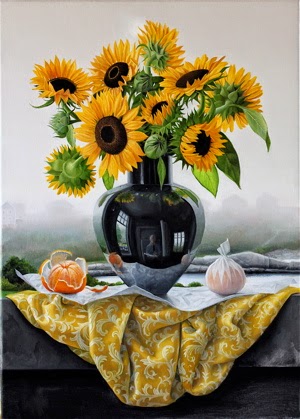
Sunflowers on Appledore
James Aponovich
oil on canvas, 32" x 26"


In October, they shut Appledore Island down. Autumn drops heavy in New England. The scarlet flames of color in the trees are like the anguished scream of nature about to extinguish herself. Dreaded winter will come, long, dark and cold.


But now it is harvest time. The air is still warm and the sunflowers are at their peak. In Italy, they are called  Girasole. Girare is the verb 'to turn', and Sole means sun, so the name connotes motion, a turning towards the sun. Turn they do, I can attest that in painting them, they behave like an inexperienced model who constantly fidgets in a pose, never still.


A QUESTION OF BALANCE

Q.      Hey Jim!   Whats with the cloth......again? You paint flowers n' stuff wicked good but I keep seeing the yellow cloth. Its old fashion and kinda boring. I dunno, what gives?

A.     Huh?


THE MOVEMENT OF WATER


Hydrangeas on the Amoskeag ( detail)
James Aponovich
oil on canvas

The textile goods produced at the Amoskeag Mills in the 19th Century were world renown. Almost every field in rural New Hampshire had a flock of Merino sheep whose wool was destined for the mills, cotton flowed from the south.
In Italy, during the Medici's, Florence rose to her glory on two things, banking and wool. The Florence, Flanders route meant that amongst other thing, artists could see each others work and ideas were exchanged.

Thematically, the woven textile is a reference to the original Amoskeag Mills. Pandora was a well known textile manufacturer and a recognizable landmark for travelers heading north to the mountains of New Hampshire.
There is also a more subtle reference....to water. The cloth and flowers sit over the Amoskeag waterfalls, so the cloth cascades over the wall to counter the unseen falls behinds it.
About the cloth......


BUSATTI

( The Textiles of Anghiari )


I first saw this particular cloth at a shop in Arezzo while in Tuscany hunting down the Piero della Francesca Trail. I immediately fell in love with it and often use it as my "go to" fabric in painting. During our last stay in Italy, Elizabeth and I, along with friends Jim and Debbie, made a pilgrimage to the Tuscan village of Anghiari to visit the flagship factory, Busatti.


For more information on our trip to Anghiari and Busatti factory click on:

APONOVICH and JOHANSSON At Home and Away