Showing posts with label Manchester. Show all posts

Monday, October 20, 2014

TURN, TURN, TURN, ( Giri, Giri ,Giri ) week 8


TURN, TURN, TURN
( Giri, Giri, Giri )
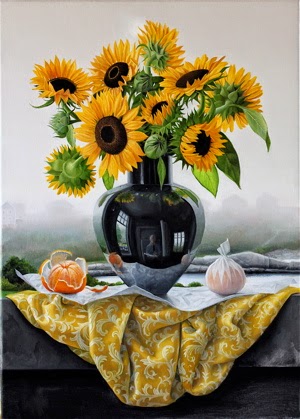


Sunflowers on Appledore
James Aponovich
oil on canvas, 32" x 26"


In October, they shut Appledore Island down. Autumn drops heavy in New England. The scarlet flames of color in the trees are like the anguished scream of nature about to extinguish herself. Dreaded winter will come, long, dark and cold.


But now it is harvest time. The air is still warm and the sunflowers are at their peak. In Italy, they are called  Girasole. Girare is the verb 'to turn', and Sole means sun, so the name connotes motion, a turning towards the sun. Turn they do, I can attest that in painting them, they behave like an inexperienced model who constantly fidgets in a pose, never still.


A QUESTION OF BALANCE

Q.      Hey Jim!   Whats with the cloth......again? You paint flowers n' stuff wicked good but I keep seeing the yellow cloth. Its old fashion and kinda boring. I dunno, what gives?

A.     Huh?


THE MOVEMENT OF WATER


Hydrangeas on the Amoskeag ( detail)
James Aponovich
oil on canvas

The textile goods produced at the Amoskeag Mills in the 19th Century were world renown. Almost every field in rural New Hampshire had a flock of Merino sheep whose wool was destined for the mills, cotton flowed from the south.
In Italy, during the Medici's, Florence rose to her glory on two things, banking and wool. The Florence, Flanders route meant that amongst other thing, artists could see each others work and ideas were exchanged.

Thematically, the woven textile is a reference to the original Amoskeag Mills. Pandora was a well known textile manufacturer and a recognizable landmark for travelers heading north to the mountains of New Hampshire.
There is also a more subtle reference....to water. The cloth and flowers sit over the Amoskeag waterfalls, so the cloth cascades over the wall to counter the unseen falls behinds it.
About the cloth......


BUSATTI

( The Textiles of Anghiari )


I first saw this particular cloth at a shop in Arezzo while in Tuscany hunting down the Piero della Francesca Trail. I immediately fell in love with it and often use it as my "go to" fabric in painting. During our last stay in Italy, Elizabeth and I, along with friends Jim and Debbie, made a pilgrimage to the Tuscan village of Anghiari to visit the flagship factory, Busatti.


For more information on our trip to Anghiari and Busatti factory click on:

APONOVICH and JOHANSSON At Home and Away


Monday, September 15, 2014

HORTENSIA / HYDRANGEA ( week 3)


Panicale, Hortensia (detail)


BALANCING ACT

Panicale's  profile is pure inspiration. It sits on a mountain and can be easily recognized from all directions.  How you see it establishes your bering. Mount Monadnock does the same thing, you know where you are by the view of the mountain. In Italy I most often see Panicale from the road to Missiano. On the left stands the Gothic Town Hall with its towering bell tower. Facing it, on the right, is the church of San Michele Archangelo. Civic on the left, and religious on the right, sound familiar? I wanted to paint Panicale, but how could I without it looking like some tourist vision? Maybe I need to abstract it a bit?


AN AUTONOMOUS LANGUAGE

Artistic vision is different. In general, deductive reasoning is not how artists interpret information. Instead of linear thinking an artists approach is more circuitious. The visual context is dismantled and reassembled spatially into a new configuration. It is like the visual arena is a puzzle that the artistic mind repurposes by forming abstract relationships. I'll try to explain.


My symbol for Panicale is a circle. The towns shape is an oval that rises circuitously to a peak and then down again. You walk round and round Panicale
 and never really come to an end. ( O.K., maybe at Aldo's for coffee.)
Sometimes you feel as if you are in an Escher print.


THE CIRCLE SQUARED


I start with the circle ( Heavenly, eternal ) and square it with right angles (corporal, earthly),
as Panicale's design is medieval, so is this.


Then, I bisect the square over and over. This is a medieval formula called the Armature of a Square. The convergence of three lines divides the square into thirds (blue lines)


I then remove the Armature and leave the horizontal lines that establish three planes ;the upper, middle and lower. Using the width of a third I inscribe a circle from the center.


This places the town and sky in the upper third, the wall and flowers in the middle and the cloth in the lower. Heaven and Earth are now aligned.


Hortensia, Panicale (in progress)
J. Aponovich
oil on canvas


The hydrangeas  (Amoskeag) from week 2 post , are doing double duty. I painted those "alla prima". After completing one flower for the Amoskeag painting I drew it onto this canvas knowing that I was going to change the color of the flowers, I applied a light underwash of red. The red will affect the color I apply and impart a little dazzle...I hope.

To be continued......


AMOSKEAG UPDATE


I have been drawing the east side pretty carefully. I know from experience that people like to see familiar buildings where they are suppose to be, but its a painting, not reality. As the old Town Hall is prominent in the Panicale painting, I made sure to paint Manchester's City Hall.