Showing posts with label New Hampshire. Show all posts

Monday, December 8, 2014

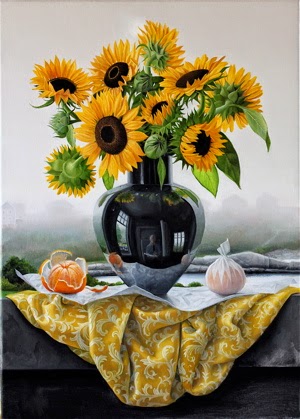
ALL THAT GLITTERS


ALL THAT GLITTERS


James Aponovich
oil on canvas, 11" x 9"


R.T.A.

R.T.A. is gallery speak for a work of art that is "returned to artist." for whatever reason, they don't want it anymore, it may take up too much space or there is little interest, but as they say," we know where it is".......
....not always.
I have had many R.T.A.'s in my career and generally speaking, they have found new homes. Sometimes they stay and occupy a prized spot on a wall, other times they find themselves back in the studio like disorderly students
 who find themselves in detention after school, they sit in the studio and the question is asked, "what is wrong with you?"
Believe me, I am very familiar with this analogy.


BLANK CANVAS BRAIN FREEZE


?
James Aponovich
Post-it Note & Ink, 20" x 16"


The blank canvas or (or page) contains unlimited potential and it is up to the artist to release the latent energy within. I have tried to explain that one method to assist the exploration is geometrical proportion, but that by itself will not necessarily get you very far, it is only a substructure. It's what you put onto it that becomes the "art", which is ineffable and impossible to teach. When a sculptor looks at an uncarved block they must envision the form they want and just remove the excess (material) to release it. A painter adds only what (material) is necessary, no more....easy to say, difficult to do.


SITTING IN DETENTION

So, here I have a painting I 'completed'  a couple of years ago. The gallery didn't want it so I brought it into the studio for a look. I decided to have another go at it but keep the theme of a bag of candy. The malted milk balls seemed dull, so to get more visual appeal I needed glitz!...and I knew exactly where to go to find it.

"I only eat candy."
       - Andy Warhol *


EYE CANDY

If you follow the 43rd Parallel due east from Peterborough, you will arrive at the Revolutionary War Capital of Exeter, New Hampshire, next door is the town of Stratham, the American home of the Swiss mega sweet corporation,
Lindt Chocolate, and they have an outlet shop!


Bins of candy at Lindt


What's the line about a kid in a candy store? This is Lindt's outlet store and it is amazing. While Beth went to the cafe for a hot chocolate ( it was a cold day)., I started digging through bins of European wrapped chocolates. I was seeking total visual eye appeal and was more than happy to be beguiled by a fancy wrapper. Armed with my bag of visual munitions, I returned to the studio for one more round with the painting......so here it is.


SAME PAINTING TWICE
                                      -with apologies to Howard Mansfield


Bag of Chocolates
James Aponovich
oil on canvas, 11" x 9"


P.S.  The obvious question arises as to why use an old canvas? Why not just start with a new one, its all about mojo. Paintings must have the flame of magic in them and if there exists only a spark ( in this case, hardly an ember), then the 'failed' canvas must be continued,
 artists must be explorers and again.....
A painting is only finished when there is nothing
more you can do to make it any better.


* Early in Andy Warhol's career this is what his response was as to why he wasn' eating at a formal, upper East Side dinner. He didn't know which fork or knife to use........brilliant response.


Monday, December 1, 2014

THE PRIMARY CHORD OR THE GORDIAN KNOT UNTIED

THE PRIMARY CHORD OR THE GORDIAN KNOT UNTIED


The most difficult color chord to work with is the primary triad of red, yellow and blue. They are the starting point in the mixing of other colors ( i.e. yellow + blue = green), but likewise they cannot be created from other colors. They don't particularly like each other so are difficult to place side by side, they each vary in chromatic intensity with yellow being the most dominate and blue least. red is very symbolic.
This chord was the starting point for the Hydrangeas Over the Amoskeag I introduced in week 2. Working with red, yellow and blue is like dealing with three chromatic divas so I needed a color that could settle this crowd down and that color is green.


This particular combination was one of the first 'scientific" color chords of the early Nineteenth  Century. It was also the first primary color chord. It was developed by none other than Johann Wolfgang Von Goethe, the German poet, dramatist and Italophile who also liked to dabble in the new science of optics. A Phd. was not required then.


IS IT FINISHED?


Hydrangeas Over The Amoskeag
James Aponovich
oil on canvas, 34" x 55"


So, here I am and the long climb  is approaching the summit. The painting of ten thousand windows and a million leaves is slowing "coming together", but exactly when do I finally put the brushes down and consider it done?
I have said before that a painting is only finished when there is nothing more you can do to make it any better. true enough, for a painting is more than the sum of its parts. By parts I mean all the complex elements of color, line,energy, visual weight, balance of imagery, proportion of areas and a myriad of other things  that all need to rush to a conclusion, a finish. But should a artist cross the threshold and seek to extend the painting it becomes "overworked." The life quickly gets sucked out of it.
The artists responsibility is to recognize the point of conclusion and there remains only one more thing to do......sign it.


Hydrangeas Over the Amoskeag  ( detail)


Monday, November 3, 2014

THE POSTSEASON


THE POSTSEASON


Three Leaves
James Aponovich
oil on panel, 14" x 11"


In New England, the fall foliage season rolls down from Canada in early October and cascades over Cape Cod and the Islands around the beginning of November. This arboreal technicolor review is witnessed by countless tourists in large buses as well as 'daytrippers' from all parts of New England, New York and beyond. They come to catch the first glimpses of the yellows, oranges, vermillion and magentas of the sugar maples and myriad of other trees. There is nothing subtle about a 'peak' New England fall.


Japanese Maple


SECOND ACT

Personally, I wait for the tide to roll back, after the maples have dropped their leaves and the tourists have bought their souvenirs and left, a quiet returns and a second 'fall' occurs. It is now time for the majestic oaks, rugged hickories and elegant birches to step forward. The oak eschews the brilliant chroma of the maple and instead dons a more regal mantle of burnt orange and russet. The hickory turns gold, the envy of any potentate or commodities trader. This thunderous chord is offset by the lyrical dance of the white birches with lemon yellow leaves. Only the beeches will keep their leaves all winter, a ghostly presence, rattling in the wind, waiting for spring.


Shagbark Hickory


NOVEMBER LIGHT

The angle of sunlight is now low and sharp, the clear, piercing light passes through the bare trees, casting long shadows on the dry fields. Deer are on the move. It is time for sheep to find winter shelter. Birds are agitated, preparing for their long flight south. Overhead, a river of hawks arrive from Mount Desert in Maine and catch the thermal updrafts above Pack Monadnock mountain and continue down  the coast.
There is a certain nostalgia or sadness to this time of year. Firewood is stacked strategically around the house. It will be needed to ward off the bitter cold of winter, gardens are put to bed and everyone waits for the first flurry of snow. Storm windows are fastened and everywhere you begin to see the unofficial flag of New England unfurl, the blue plastic tarp that covers everything for the winter. 


LATE HARVEST AT LULL FARM

"Live Free and Farm"


This is also the time for the rural farmstands. Not far from us is one of the best, Lull Farm, in Hollis, New Hampshire. I spend a part of my youth nearby at my Uncle's farm. Here bins of apples compete with mountains of pumpkins and squash for attention. The weekends find the stand crowded with families in festive moods. Children scamper over piles of pumpkins trying to find the perfect one, classic country mirth. It is an event that reminds me of a Brueghel painting.


 The Wedding Dance, 1566
Brueghel


Tip 'O The Hat and my thanks to  our friends Judith and Robert Oksner
for on call editing 


Monday, October 20, 2014

TURN, TURN, TURN, ( Giri, Giri ,Giri ) week 8


TURN, TURN, TURN
( Giri, Giri, Giri )


Sunflowers on Appledore
James Aponovich
oil on canvas, 32" x 26"


In October, they shut Appledore Island down. Autumn drops heavy in New England. The scarlet flames of color in the trees are like the anguished scream of nature about to extinguish herself. Dreaded winter will come, long, dark and cold.


But now it is harvest time. The air is still warm and the sunflowers are at their peak. In Italy, they are called  Girasole. Girare is the verb 'to turn', and Sole means sun, so the name connotes motion, a turning towards the sun. Turn they do, I can attest that in painting them, they behave like an inexperienced model who constantly fidgets in a pose, never still.


A QUESTION OF BALANCE

Q.      Hey Jim!   Whats with the cloth......again? You paint flowers n' stuff wicked good but I keep seeing the yellow cloth. Its old fashion and kinda boring. I dunno, what gives?

A.     Huh?


THE MOVEMENT OF WATER


Hydrangeas on the Amoskeag ( detail)
James Aponovich
oil on canvas

The textile goods produced at the Amoskeag Mills in the 19th Century were world renown. Almost every field in rural New Hampshire had a flock of Merino sheep whose wool was destined for the mills, cotton flowed from the south.
In Italy, during the Medici's, Florence rose to her glory on two things, banking and wool. The Florence, Flanders route meant that amongst other thing, artists could see each others work and ideas were exchanged.

Thematically, the woven textile is a reference to the original Amoskeag Mills. Pandora was a well known textile manufacturer and a recognizable landmark for travelers heading north to the mountains of New Hampshire.
There is also a more subtle reference....to water. The cloth and flowers sit over the Amoskeag waterfalls, so the cloth cascades over the wall to counter the unseen falls behinds it.
About the cloth......


BUSATTI

( The Textiles of Anghiari )


I first saw this particular cloth at a shop in Arezzo while in Tuscany hunting down the Piero della Francesca Trail. I immediately fell in love with it and often use it as my "go to" fabric in painting. During our last stay in Italy, Elizabeth and I, along with friends Jim and Debbie, made a pilgrimage to the Tuscan village of Anghiari to visit the flagship factory, Busatti.


For more information on our trip to Anghiari and Busatti factory click on:

APONOVICH and JOHANSSON At Home and Away


Monday, October 6, 2014

THE FOOD ISSUE ( week 6 )

THE FOOD ISSUE


Basket of Fruit with Grapes and Morning Glories
James Aponovich
oil on canvas, 26" x 26"


YOU WANT FRENCH OR ITALIAN TONIGHT ?

It is said that if you ask 100 professional French chefs to each make a Bearnaise  sauce you will get 100 sauces exactly alike. On the other hand, ask 100 Italian cooks to make a ragu and you most certainly get 100 versions along with some heated arguments. In Italy things change , not just from region to region, but even town to town..
So, when I speak of Italian food, I am referring to the places I am most familiar with, Umbria, Tuscany and Rome. When I speak of food from my native New England, the conversation
 gets kind of sparse.....what dishes most represent New England? bluefish and beans? New England boiled dinner? Boston cream pie?


THE ROGER SWAIN SIX

Roger Swain, the eminent Botanist, Horticulturalist, Public Television personality, listed only six indigenous edible crops in the United States, they are:

Fox grapes ( Concord grapes)
sunflowers
wild rice
cranberries
blueberries
pecans

"That's piss poor!"

                       -R. Swain

Throw in a roasted wild turkey and you got a pretty decent Thanksgiving dinner. My point is that we don't have much to work with here in New England......well, thinking about it, there is one thing we do have.............


Lobster
James Aponovich
oil on panel, 16" x 12"


HOMERUS AMERICANUS

The North American lobster abounds off the coast of New England. Purists say you must go Down East in Maine to where the frigid Labrador current is home to the best lobsters. Having lived there, I cannot disagree.
Although most people prefer to dunk their boiled lobster in copious amounts of melted butter, ( and yes the bibs you wear around your neck do make you look silly ) there remains an ardent group that searches out the quintessential New England lobster recipe.


Sanders Lobster Pound, Portsmouth, NH.


Inside Sanders Lobster Pound


THE ALL AMERICAN
NEW ENGLAND
LOBSTER ROLL


Some recipes are all the more difficult due to their simplicity.
 Try boiling an egg.....perfectly.
It  may be axiomatic that less is more, but what is most important here is balance.
If this were a painting ( and it is a work of art) I would be referring to proportion, how one area relates to and balances the other. So, I have chosen to profile the lobster roll not because of its "chefy" complexity, but  because of its seemingly infinite variations on a relatively simple list of ingredients.


INGREDIENTS

Lobster, freshly caught is best, preferably from waters on or above the 43rd Parallel. Boiled and cooled then diced or torn. If you can buy shucked lobster meat, make sure it is fresh.
Mayonnaise, yes, some is necessary, it is after all, lobster salad. The amount you add is up to you. 
Make your own mayonnaise or use Hellman's, or if you are a true New Englander, Cains.
Celery, crunchy and finely diced.
Scallion, only if you must.
Lemon Juice, for brightening
Salt & Pepper
New England Style Hot Dog Roll,  buttered and toasted.
A bag of Cape Cod potato chips, if you live in Maine, Humpty Dumpty potato chips.

Prepare the lobster salad, it should be chilled, but never cold. Keep the lobster pieces the right size to comfortably fit the roll. Reserve the claw meat to decorate the top. Brush the sides of the roll with melted butter and place on a hot pan until toasted a golden brown, open the roll to release some of the heat and fill with lobster salad mixture, do not overfill.


Lobster roll from Alisson's
Kennebunkport, Maine


There is a continuing controversy that never seems to be resolved....
What is the best thing to drink with lobster?
There is nothing wrong with a tall glass of Geary's Ale to have with your lobster.
But, our choice  of beverage is a cold crisp Prosecco when lobster is on the menu.
Our  favorite is Turina Lugana Spumante Brut.
CHEERS!


Monday, September 29, 2014

APPLEDORE, Isles of Shoals ( week 5 )


APPLEDORE,  ISLES OF SHOALS


"It must be so nice to be able to paint on an island off the coast of New England...."
"Appledore ain't exactly Martha's Vineyard, lady."


West Wind, Isles of Shoals, 1904
Childe Hassam

The Isles of Shoals are a group of islands lying ten miles off the coast of New England and are divided between Maine and New Hampshire. Appledore, Smuttynose and Duck belong to Maine, Star and White to New Hampshire. It is not easy to go ashore on Appledore. Both Cornell and the University of New Hampshire have research facilities on the Island. Beth and I managed to hitch a ride on a supply boat out of Portsmouth, NH.


BLACK BACKS AND MUSKRATS


Appledore Basket
James Aponovich
oil on canvas, 18" x 24"


In many ways Appledore is not a comfortable place. Hundreds of Black Backed gulls fill the air with their screams. Don't go there when they are fledging, they will attack you. Their white droppings are matched by the brown of the muskrats that roam the island, fearless and nearly blind. Poison Ivy rambles everywhere. Rogue waves have been known to sweep people off the rocks. Great Whites feed on the seals off Duck Island. Yes, the wild is still here.


AN ISLAND GARDEN


Poppies, 1891
Childe Hassam


" Like the musician, the painter, the poet, and the rest, the true lover of flowers is born, not made."
                                                                                             Celia Thaxter

I had heard of Appledore as the summer home of Celia Thaxter, the Nineteenth Century poet and celebrated gardener who would host artists and intellectuals in her home. The American Impressionist painter, Childe Hassam was one of the more noteworthy and spent some twenty summers on the island.


DEATH BY WATER


Little Pond, Appledore
James Aponovich
oil on canvas


The Little Pond, Appledore,  1890
Childe Hassam

Thaxter had a charming summer cottage near her father's large hotel on the island. Many people from Boston would travel to the island to take in the therapeutic "airs". The Boston painter, William Morris Hunt, suffering from depression came to Thaxter's cottage on advice from his doctor. One morning she found his body floating in a pond behind her house, an apparent suicide. Eventually fire swept through both her father's hotel and later her cottage, leaving only foundation rubble. Her garden survived and is currently being restored. Appledore has a melancholy side.


ON THE OTHER HAND


Appledore in Fog
James Aponovich
oil on canvas, 20" x 22"

Beth and I came to see the garden and to paint it. It was a brilliant, sunny day and as I painted, I struggled with the buildings that survived the fire, as well as
 the large watchtower, a remnant of World War II.

Earlier, as we were approaching the island, I had noticed something on the horizon. I knew all too well, having once lived on the coast of Maine.....fog. The fog banks that roll in from the Gulf of Maine are thick and dangerous. Mariners say, "the ceiling has dropped," and so it had.......
But it erased the watchtower and softened the buildings, I loved it. It reminded me of a painter from Prouts Neck, Maine


The Artist's Studio in an Afternoon Fog, 1894
Winslow Homer


They will close Appledore soon for the winter. The ice and snow are too harsh, but come next season I will return whenever I need to wash my vision with sea, rock and gulls. Just watch where you step.


Agapanthus, Appledore
James Aponovich
oil on canvas


Monday, September 22, 2014

THE LANDSCAPE OF TIME AND OF TIME LOST (week 4)

THE LANDSCAPE OF TIME AND OF TIME LOST


The landscape of Italy ( here I am referring to Tuscany and Umbria) is not necessarily overpowering. Romantically breathtaking, yes, but it is too refined and well thought out for high drama. The land has been sculpted by a succession of hands for thousands of years. The layers of numerous epochs reveal themselves subtly. An Etruscan wall borders a path trod by pilgrims in the 10th Century. It is a grand palimpsest  of time, but if you seek raw splendor, then you must go north to the Alps or better yet, cross the ocean to the "New World."


CHASING EDEN


Little Harbor ( New Hampshire)
James Aponovich
oil on canvas

Early in the 19th Century, European artists grew bored with this groomed, orderly landscape. They had read Rousseau and they wanted to embrace the primitive, aboriginal eden, untouched by the European model. They came to America, primarily to the coast of New England and the White Mountains of New Hampshire. Here, they thought they had found the raw, savage nature they were seeking.... until someone said,"the mountains are better out West.".......Bye.


THE FALLOW LAND

What happens when the vision of the landscape dies? We, in the United States, have always been interested in the next, better thing. We are always ready to drop what we have and move on to the next chapter. Our attention span is measured  not in minutes but seconds. A landscape thrives in direct proportion to the love and need we imbue it with. When abandoned and we turn our backs to it, the wild returns. By the wild, I am not referring to the trees reclaiming the land, but something more sinister, highways, malls, fun parks, and fast food joints.


LANDS END AND A BIT BEYOND


North Wind Clearing: Appledore Island
James Aponovich
Oil on canvas

The vision still breathes, but you must look for it, you have to seek it out. One such place lies seven miles off the New England coast, again, on the 43 Parallel, The Isles of Shoals. The original wild is still very much evident there.

Let us make our visit.

To be continued........


PANICALE HORTENSIA PAINTING UPDATE


Panicale, Hortensia ( in progress)
James Aponovich

Uh Oh....Heaven and Earth ain't workin' together. It's getting away from me a bit and I think I know why. You can paint from your mind or you can paint from your heart, rarely both. This is like sucking on a lemon. I'll see if I can fix it.


AMOSKEAG HYDRANGEA UPDATE


Amoskeag, Hydrangea ( underpainting/ in progress)
James Aponovich

"Va bene!"  The Italians would say. It is going well. It has taken a while to get the East Side washed in. Now, onto the West Side.


Monday, September 15, 2014

HORTENSIA / HYDRANGEA ( week 3)


Panicale, Hortensia (detail)


BALANCING ACT

Panicale's  profile is pure inspiration. It sits on a mountain and can be easily recognized from all directions.  How you see it establishes your bering. Mount Monadnock does the same thing, you know where you are by the view of the mountain. In Italy I most often see Panicale from the road to Missiano. On the left stands the Gothic Town Hall with its towering bell tower. Facing it, on the right, is the church of San Michele Archangelo. Civic on the left, and religious on the right, sound familiar? I wanted to paint Panicale, but how could I without it looking like some tourist vision? Maybe I need to abstract it a bit?


AN AUTONOMOUS LANGUAGE

Artistic vision is different. In general, deductive reasoning is not how artists interpret information. Instead of linear thinking an artists approach is more circuitious. The visual context is dismantled and reassembled spatially into a new configuration. It is like the visual arena is a puzzle that the artistic mind repurposes by forming abstract relationships. I'll try to explain.


My symbol for Panicale is a circle. The towns shape is an oval that rises circuitously to a peak and then down again. You walk round and round Panicale
 and never really come to an end. ( O.K., maybe at Aldo's for coffee.)
Sometimes you feel as if you are in an Escher print.


THE CIRCLE SQUARED


I start with the circle ( Heavenly, eternal ) and square it with right angles (corporal, earthly),
as Panicale's design is medieval, so is this.


Then, I bisect the square over and over. This is a medieval formula called the Armature of a Square. The convergence of three lines divides the square into thirds (blue lines)


I then remove the Armature and leave the horizontal lines that establish three planes ;the upper, middle and lower. Using the width of a third I inscribe a circle from the center.


This places the town and sky in the upper third, the wall and flowers in the middle and the cloth in the lower. Heaven and Earth are now aligned.


Hortensia, Panicale (in progress)
J. Aponovich
oil on canvas


The hydrangeas  (Amoskeag) from week 2 post , are doing double duty. I painted those "alla prima". After completing one flower for the Amoskeag painting I drew it onto this canvas knowing that I was going to change the color of the flowers, I applied a light underwash of red. The red will affect the color I apply and impart a little dazzle...I hope.

To be continued......


AMOSKEAG UPDATE


I have been drawing the east side pretty carefully. I know from experience that people like to see familiar buildings where they are suppose to be, but its a painting, not reality. As the old Town Hall is prominent in the Panicale painting, I made sure to paint Manchester's City Hall.


Monday, September 8, 2014

HYDRANGEA / HORTENSIA ( week 2 )


La Cucina ( detail)
James Aponovich
oil on canvas


People in Panicale garden where they can. Some are fortunate and own a private enclosed garden, others use windowsills, roof terraces or even doorways to grow the most amazing flowers.


Our friend Janelle  on her Panicale "garden stairs"


Perhaps it is the shade afforded by the ancient walls that give the plants some needed relief from the scorching summer sun. One of my favorite flowers is the Hydrangea, which Italians
 call Hortensia ( the "H" is not pronounced ). Nowhere have I seen them more luxurious than on the streets of Panicale, that is, until Elizabeth and I began growing them here in New Hampshire.


Study for Hydrangeas on the Amoskeag
James Aponovich
pencil on paper, 13" x 21"


A RIVER RUNS THROUGH IT

New Hampshire is blessed with many lakes, rivers and streams. The major rivers provide the driving element that powered the mills during the Industrial Revolution. Manchester is the largest city and has always been a significant industrial center as the Merrimack River runs through it. When Beth and I were first married we lived in Manchester and our daughter, Ana, was born there.

It was in the early 19th Century that the falls, called by the Indians "Amoskeag" were dammed so power could be harvested for the mills. The Indians harvested Atlantic Salmon there, but the dam put a stop to that for two hundred years. Henry David Thoreau, during his epic journey up the Concord and Merrimack Rivers passed these mills as they were being built.

The city of Manchester, New Hampshire was built on the banks and is bisected by the Merrimack River. Simply stated, on the East  ( or left in drawing)is the commercial district, and on the West ( right) lies the residential  and religious  buildings. Much has evolved, now the city  hosts one of the great small museums of the Northeast, The Currier Museum.


POWER OF THE CENTER


Hydrangeas on the Amoskeag 
( in progress /detail )
James Aponovich
oil on canvas,  34" x 55"


The flowers you see here are cut from our garden. I first determine the grouping and then bring into the studio one flower at a time. It takes about one day to complete one flower. I paint those flowers directly onto white canvas with no underpainting. In Italian this technique is called "alla prima", or all at once.


The overall idea here is to funnel the viewers down the river so that everything converges on the center of the rectangle. To emphasize this the flowers form a loose "V" shape to counter the banks of the rivers inverted "V". The fabric will also repeat this...
repetition......repetition.


THE INVISIBLE SUBSTRUCTURE

so far, everything is about the surface, the obvious "stuff". It is what the Chinese call
"The Manifest". However, it is underneath in "The Hidden" where the real important elements exist. Let me try to explain.

The canvas is a "Golden Section" rectangle. It is  based on a numerical sequence codified by the Roman Architect Vitruvius in the First Century B.C. It actually dates back to the Greek Mathematician Pythagoras, but it is now called the Fibonacci Series.
You start with 1, then add 1 to get 2, add 2 plus 1 to get 3, 3 plus 2 to get 5, etc.
The ratio between the numbers remains the same as they get larger and larger.
1  1  2  3  5  8   13   21   34   55   89  and so on.
Remember DaVinci's naked guy with the outstretched arms (and other parts) ?
The same deal.


THE POWER OF ONE

1 plus 1, well, that is a square, one side equals one side. So, I took two squares and overlapped them until I found the sweet spot, the Golden Section Rectangle. The size of the canvas is 34" x 55". You can find these numbers along side each other in the Fibonacci Series mentioned above.


Here are the two overlapping squares and the breakdown of the numerical sequence....
So what ! you say.


O.K. Now the left square is the East side and the right square is the West side. Where they overlap is where the flowers are. Plus, if I make two smaller overlapping squares
with the two sides ( not the flower part ) it delineates where the entire horizontal  stretch of the city and river are situated. This is called composition.
Now I have to paint "the stuff" and that is the hard part.


To be continued......